
In late January, I began running again after a three-year absence. Not with a programme, not with a target pace or distance, and certainly not with a nutritional plan. I began because the editorial team at Rokan Gazette had asked whether I would be willing to document the experience from a food and weight perspective — keeping only a food journal and a simple movement log for eight weeks. I said yes, and then regretted it immediately. This is what I found.
Tobias Marsden is a London-based food writer and occasional runner. This article documents his personal observation over eight weeks (January–March 2026) and does not represent guidance for any other person's eating or movement pattern.
The First Fortnight: Movement and the Plate Remain Strangers
The assumption going into the first two weeks was that increased movement would produce an immediate and proportional increase in appetite. This did not happen. The first run — a slow, embarrassing 2.8 kilometres along the Regent's Canal on a Tuesday morning — was followed by a normal breakfast, a normal lunch, and a dinner only marginally larger than usual. The food journal noted mild fatigue in the afternoon, a slightly earlier hunger signal at dinner, and an unusual craving for protein-rich foods by the evening.
By the end of the first week — three runs, each under 4 kilometres — the food journal showed no significant change in daily eating pattern. The portions remained comparable to the week prior, the meal timing stayed consistent, and the food choices were broadly the same. The only notable difference was a persistent preference, observed on running days, for warm rather than cold meals in the evening. This was attributed to physical temperature and the colder early mornings of January rather than any nutritional shift.
The second week introduced a fourth run and extended the individual distances to between 4 and 5 kilometres. The food journal now began to show something more interesting: on non-running days, appetite appeared reduced relative to running days. This inverse relationship — appetite sharpened by movement, quieted by rest — is documented in research on exercise and appetite regulation, and would become one of the clearest patterns of the eight-week record.

The Appetite Shift: When Movement Begins to Reshape the Plate
By the third week, a pattern had become legible in the food journal. The running days — which by this point numbered four per week — were producing consistently different food selections at dinner than the rest days. Running days showed a higher proportion of protein-rich whole foods: eggs, legumes, oily fish, whole-grain combinations with substantial plant protein components. Rest days showed a return toward carbohydrate-heavier meals — pasta, bread, rice — without the protein emphasis.
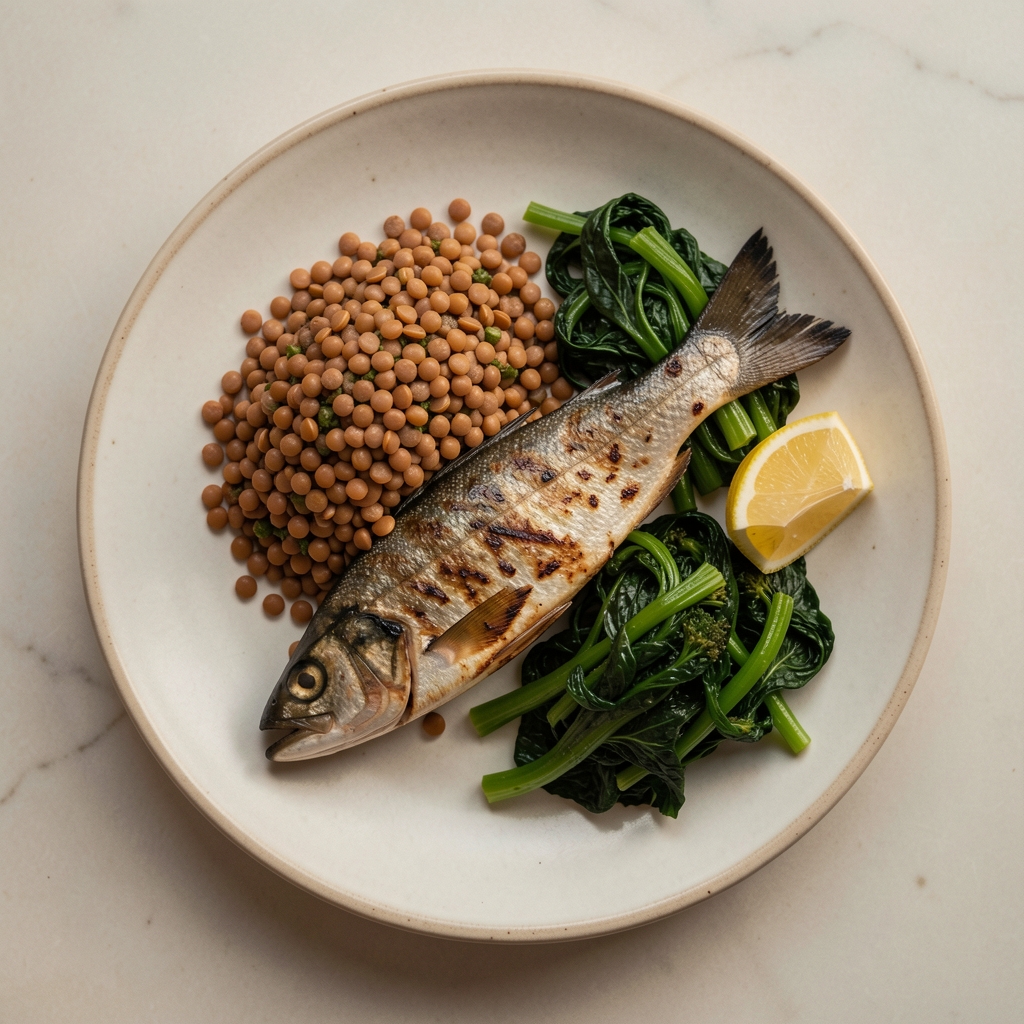
This was not a deliberate dietary choice. The food journal made it clear that the selections on running days were intuitive rather than planned — the hand reaching for the lentils and sardines on a Thursday after a morning run was following a signal rather than a strategy. The signals were appetite-quality signals: a running-day appetite had a different character to a rest-day appetite. It was more insistent in the evening, less easily satisfied by refined carbohydrates, and quicker to arrive at satiation with whole-food, protein-forward meals.
The fourth week introduced a notable disruption: a head cold that eliminated running for six days. The food journal entries from this period are some of the most instructive in the record. The loss of movement produced an immediate flattening of appetite quality — appetite became less differentiated, more constant across the day, and more oriented toward comfort foods. This was not a catastrophic nutritional event; the quantities remained similar. But the quality of the appetite — its rhythmic structure tied to physical activity — was absent, and the plate showed it.
Weight, Food Selection, and the Accumulating Record
The decision not to weigh myself at the start of the eight weeks was deliberate, and I maintained it throughout. The record being kept was of eating patterns and food choices, not of weight as a numerical measure. Nevertheless, by the sixth week, the food journal itself was registering changes in the implicit feedback system between movement, appetite, and food selection that have predictable relationships with body weight.
The most consistent change across the full eight weeks was in the composition of the evening meal on running days: a sustained shift toward whole foods, plant-based components, and protein-rich ingredients, and away from the refined grain and processed food heavy dinners that had characterised the period immediately before the record began. This shift was not dramatic in any single week. Accumulated across eight weeks — approximately 32 running evenings — it represented a material change in the overall diet pattern.
Published research on exercise and dietary quality consistently notes that regular moderate aerobic activity correlates with improved dietary choices in observational studies — not through willpower or intention, but through the physiological reshaping of appetite signals. The food journal is a first-person record of exactly this mechanism: movement produces a different quality of appetite, and a different quality of appetite produces different food choices, and different food choices, sustained over weeks, produce different patterns of weight.
What the Evidence-Informed Framework Adds to the Field Notes
Eleanor Whitfield, reviewing the eight weeks of records for this article, noted that the appetite pattern observed in the journal is consistent with what the nutritional research literature describes as the "exercise-appetite feedback loop" — a well-documented but frequently misrepresented dynamic in popular nutrition writing. The misrepresentation usually takes the form of either overclaiming ("exercise suppresses appetite") or underclaiming ("exercise makes you hungrier, so it won't help with weight"). Both framings are too simple.
What the research and the food journal both suggest is a more nuanced picture: moderate, consistent movement reshapes appetite in the direction of protein-rich whole foods and away from refined, ultra-processed components — not because of willpower, but because the biochemical character of exercise-produced hunger is different from sedentary-state hunger. Regular movement also supports an active daily rhythm that structures the day in a way that tends to produce more regular and considered eating patterns overall.
The practical implication, noted in the editor's review of the record, is not "run to lose weight" — a framing that misses the complexity. It is closer to: regular moderate movement, maintained as a consistent daily rhythm rather than a sporadic intense event, creates the conditions in which gradual, sustainable changes to food selection tend to occur naturally. The weight relationship follows from the food selection relationship, not from the calorie expenditure of the movement itself.
Eight Weeks and What They Produced
I am still running. The distance has extended to a manageable 7 kilometres on longer days, and the food journal — which I expected to abandon within the first fortnight — has continued without a single missed entry. What eight weeks of combined movement and food record-keeping produced was not a programme, not a set of rules, and not a transformation story. It produced a more detailed understanding of my own appetite — its character, its responsiveness to physical activity, and its patterns across the week.
The body weight relationship, for anyone reading this in hope of a specific answer: at the end of eight weeks, the clothes fit differently. Not dramatically, not in a before-and-after sense. In the quiet, accumulating way that eight weeks of better food choices, made from a different quality of appetite, tend to produce. That is not a number or a result. It is a pattern — and patterns, as Rokan Gazette has always maintained, are what the food journal exists to make visible.
The record continues. The next entry — if the Gazette will have it — will cover the April transition: the shift to longer evenings, the change in running conditions, and what the improved seasonal produce of spring does to a plate that has spent two months calibrating to winter's narrower variety. It should be interesting. The notebook is already open.
- 01. Regular moderate movement reshapes appetite quality — producing a different hunger character on active days that tends toward protein-rich whole foods and away from refined or ultra-processed components.
- 02. The relationship between physical activity and body weight operates primarily through food selection rather than calorie expenditure — a distinction that is visible in a sustained food journal but lost in simple exercise-tracking approaches.
- 03. Disruptions to movement (such as illness) flatten the appetite pattern and reduce the dietary quality signal — providing evidence that the relationship is dynamic and sustained only by consistent activity.
- 04. Gradual weight change accumulates quietly across weeks of improved food selection — not through dramatic intervention but through the sustained pattern that consistent movement and honest food journalling together support.

Tobias Marsden
Tobias Marsden is a London-based food writer with a background in observational nutrition writing. He contributes periodically to Rokan Gazette, focusing on the intersection of movement and eating patterns. This article represents his first sustained food journal record, maintained over eight weeks in early 2026.
More from the Archive